From Policy to Culture: Using Holiday Rules to Strengthen Team Morale
Holiday policies quietly shape company culture. Learn how to design and manage your holiday policy in a way that builds trust, supports well-being, and reinforces the culture you want—backed by data from Leavo.

From Policy to Culture: Using Holiday Rules to Strengthen Team Morale
Holiday policies are more than an HR formality—they send powerful signals about trust, flexibility, and work–life balance. When your rules are unclear or inconsistently applied, team morale takes a hit. When they’re transparent, fair, and easy to use, they become a cornerstone of a healthy culture.
This article explores how to use your holiday policy as a cultural lever, and how a platform like Leavo helps you keep practice aligned with your cultural intent.

1. What Your Holiday Policy Tells People About Your Culture
Employees read between the lines of your policy. Whether you intend it or not, they hear messages like:
- "We trust you" (or don’t) based on how much scrutiny requests get.
- "We care about your life outside work" (or don’t) based on how easy it is to take time off.
- "We’re consistent and fair" (or not) based on how approvals differ across managers.
Common cultural signals baked into holiday policies
- Strict, opaque rules
Signal: Control, low trust, and an assumption that people may abuse the system. - Flexible, yet poorly enforced rules
Signal: Nice intentions, but disorganization—leading to burnout for conscientious employees. - Clear, flexible, data-backed system
Signal: High trust, adult-to-adult relationships, and professional operations.
Your goal is the third option: a holiday policy that supports psychological safety, enables rest, and still maintains operational control.
2. Build Cultural Principles Into the Policy Wording
Don’t hide your cultural intent; state it.
Start your holiday policy with a short section like this:
Our Approach to Time Off
------------------------
We believe regular rest is essential to sustainable high performance.

Our holiday policy is designed to:
- Encourage everyone to take meaningful breaks.
- Treat people fairly and transparently.
- Ensure our customers and teams are always supported.

We use Leavo to manage holiday requests consistently across the company.
This framing shapes how employees interpret the detailed rules that follow.
3. Design HR Strategies That Encourage Time Off, Not Just Permit It
Simply allowing holidays isn’t enough. Many employees (especially high performers) need explicit encouragement and friction-free processes.
Strategy 1: Set minimum usage expectations
Instead of only talking about maximum entitlements, define a minimum recommended usage:
- Example: “We expect everyone to take at least 80% of their annual leave each year.”
In Leavo, track unused leave and gently intervene.
Strategy 2: Normalize visible time off
- Encourage managers to log their own holidays in Leavo and talk about it.
- Share aggregated stats (e.g., "75% of our team has already booked at least one break this quarter").
This demonstrates that time off is expected, not penalized.
4. Use Leavo to Remove Administrative Friction
Friction in the holiday process sends a silent message: “Your time off is a problem to solve.” Removing that friction is a powerful cultural signal.
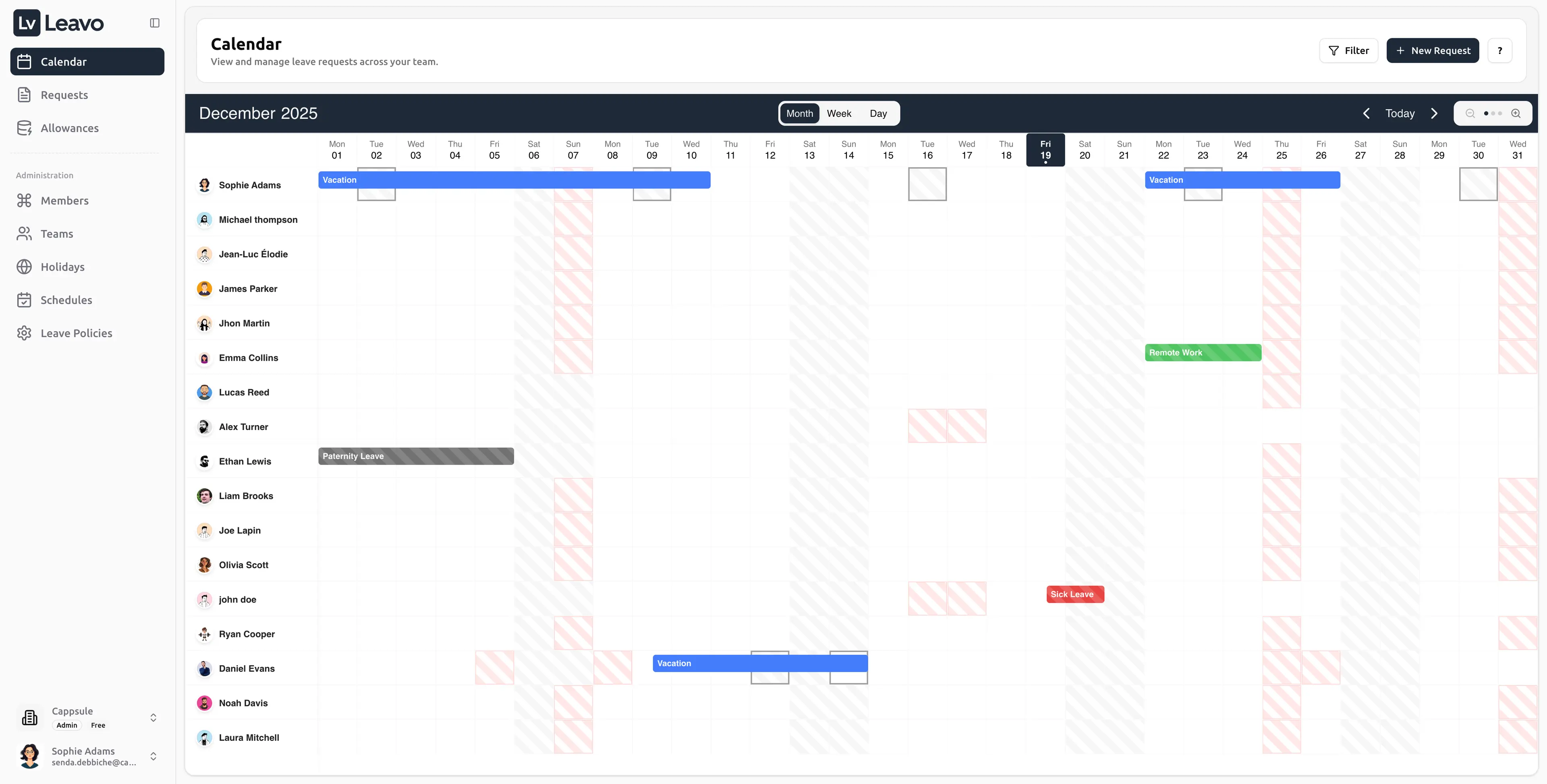
Ways Leavo can reduce friction
- Self-service balances: Employees see remaining leave balances without emailing HR.
- Clear timelines: Configure and communicate SLA for approvals (e.g., 2–3 business days).
- Real-time notifications: Automatic emails alerts when requests are approved/declined.
- Shared calendars: Colleagues can coordinate without long email threads.
These features support a culture of autonomy and clarity.
5. Ensure Consistency Across Managers and Locations
One of the biggest threats to team morale is inconsistency: one team gets flexible treatment, another faces hard lines.
Standardize rules, enable human judgment inside clear boundaries
Using Leavo’s configuration options, HR can:
- Set company-wide rules: notice periods, carry-over limits, blackout dates.
- Apply location-specific rules: statutory minimums, public holidays.
- Give managers room for case-by-case decisions, as long as they operate within system-enforced boundaries.
This approach balances standardization with human discretion.
5. Treat Peak Seasons as Cultural Moments, Not Just Scheduling Headaches
Holiday peaks (Christmas, Eid, Diwali, summer school breaks, etc.) are where people really observe whether your culture lives up to your values.
Create a fair and humane approach to peak periods
- Publish clear rules and timelines for submitting requests.
- Use Leavo’s timestamped requests to support first-come, first-served.
- Rotate priority for popular dates year to year.
- Keep a small discretionary pool of days for special circumstances (e.g., long-distance travel to see family).
Communicate with empathy
When declining a request during a peak period:
- Reference the visible team calendar and policy rule.
- Offer alternative dates.
- Acknowledge the disappointment.
This combination of transparency and empathy protects trust, even when the answer is "no".
6. Align Holiday Policy With Broader Well-being Initiatives
Your holiday policy should complement, not compete with, other well-being efforts.
Integrate with flexible working and remote policies
- Clarify that flexible working ≠ holiday. Time off should remain protected, non-working time.
- In Leavo, keep holidays clearly distinct from work-from-home or flex time arrangements.
Use data to support burnout prevention
Leavo can help you spot patterns:
- Employees who haven’t taken any leave for >4–5 months.
- Teams that repeatedly cancel or move holidays due to workload.
- Year-on-year increases in carry-over.
7. Involve Employees in Policy Design and Review
Culture is co-created. If your holiday policy is written in isolation, it may clash with lived reality.
Practical participation mechanisms
- Focus groups with representatives from different departments and locations.
- Short online survey asking:
- "Is it easy to take holidays when you need them?"
- "What’s one change that would make the holiday process feel fairer?"
- Invite volunteers to join an annual policy review panel.
Summarize how feedback influenced changes and publish this alongside the policy. This visibly connects employee voice with HR strategy.
8. Storytelling and Rituals: Make Time Off Part of Your Narrative
Policies and systems are only half the picture; stories and rituals cement culture.
Ideas to normalize and celebrate time off
- Encourage teams to share anonymized "best break" stories in internal channels.
- Run a quarterly "Plan Your Break" campaign reminding people to book.
- Have leaders share how their time off improved their work.
In all of this, Leavo acts as the single source of truth for:
- How much leave people have.
- Which periods are already popular.
- Whether you’re trending toward healthy or unhealthy usage patterns.
9. Culture-Focused Holiday Policy Checklist
Use this checklist to ensure your policy supports, not undermines, the culture you want.
Clarity & intent
- Policy explicitly states your philosophy on rest and work–life balance.
- Rules are written in plain language with examples.
- Leavo is referenced as the central place to manage holidays.
Fairness & consistency
- Approval criteria and peak-period rules are transparent.
- System-enforced rules in Leavo reduce room for arbitrary decisions.
- HR reviews data regularly for cross-team inconsistencies.
Encouragement & well-being
- There is a stated expectation that people use most of their leave.
- Under-usage is monitored via Leavo and followed up supportively.
- Holiday policy aligns with other well-being initiatives.
Participation & evolution
- Employees can give feedback on the policy at least annually.
- Changes are communicated along with the reasons behind them.
- Policy text and Leavo configuration are updated together.
10. Bridging the Gap Between Policy and Lived Experience
Your holiday policy is one of the clearest day-to-day expressions of what you value as an organization. When policy, practice, and technology align:
- Employees feel trusted and respected.
- Managers feel empowered and supported, not stuck in difficult judgment calls.
- HR gains data-driven insight into morale and resourcing.
By pairing thoughtful policy design with a robust leave management platform like Leavo, you can turn something often seen as admin overhead into a powerful driver of team morale and a healthier, more sustainable culture.